Alcohol and Cannabis Use Predicted by Affect-Urgency Interactions in Everyday Life
Feb 1, 2026· ,,,,,,,·
0 min read
,,,,,,,·
0 min read
Jonas Dora
Connor McCabe
Megan Schultz
Christine Lee
Yuichi Shoda
Megan Patrick
Gregory Smith
Kevin King
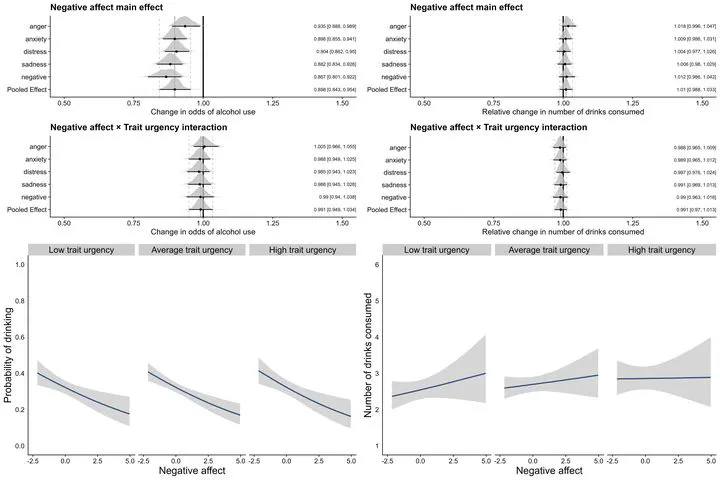 Image credit: Jonas Dora
Abstract
The hypothesis that urgency, a trait quantifying individual differences in impulsive behaviors driven by intense emotions, moderates associations between affect and alcohol use has received inconsistent support in ecological-momentary-assessment research. In this Registered Report, we tested whether trait- and state-level urgency moderate affect-substance use (alcohol and cannabis use) associations in young adults. Four hundred ninety-six adults (ages 18–22) completed ecological-momentary-assessment surveys five times daily across 32 days over 8 weekends. Positive affect was associated with increased alcohol-use probability, and negative affect was associated with decreased alcohol-use probability; cannabis use showed minimal associations with daily affect. Contrary to hypotheses, we found minimal evidence that urgency moderated daily affect-substance-use associations. Interaction effects were consistently estimated around the null value with narrow credible intervals. Results challenge theoretical predictions about urgency’s role in emotion-driven substance use and support simpler affect-substance-use models.
Type
Publication
Clinical Psychological Science