Alcohol and Cannabis Use Predicted by Affect-Urgency Interactions in Everyday Life
In this paper, we show (once more) that, unlike some prior research claims, impulsivity traits DO NOT moderate affect-substance associations in EMA data.
Feb 1, 2026
Testing the robustness of daily associations of affect with alcohol and cannabis use
In this paper, we perform a Specification Curve Analysis to show that assocations between negative/positive affect and alcohol and cannabis use in EMA data are robust to hundreds of different specializations of the hypothesis.
Jan 1, 2026
Seven Symptoms Over Nearly 4,000 Days: Item-Level Variability in the Psychometric Properties of Daily Alcohol Use Disorder Symptoms in Young Adult Drinkers
In this paper, we show via IRT how different daily measures of AUD symptoms perform in EMA data.
Jan 1, 2026
Daily Self-Control Demands and Loss of Control Over Drinking: The Moderating Role of Trait Impulsivity and Peer Exposure
In this paper, we report a study that shows, contrary to some prior research, that perceived self-control demands are not associated with same-day loss of control over drinking in young adults.
May 1, 2025
Within-Day Associations Between Affect and Intentions to Drink Alcohol in Adolescents and Young Adults: A Registered Report
In this paper, we explore one possibility why positive affect predicts alcohol use in daily life, which is that the associations is reversed (affect increases in anticipation of drinking). We found some evidence for this by looking at people's intentions to drink.
Apr 1, 2025
Characterizing the momentary association between loneliness, depression, and social interactions: Insights from an ecological momentary assessment study
Experiences of loneliness predict depressive symptoms prospectively for about 5 hours in daily life, but this association is not moderated by frequency and quality of social interaction.
Sep 1, 2024
Negative urgency as a state-level process
This EMA study suggests that people are more impulsive in moments high in negative emotions, but this association is not moderated by global reports of negative urgency.
May 1, 2024
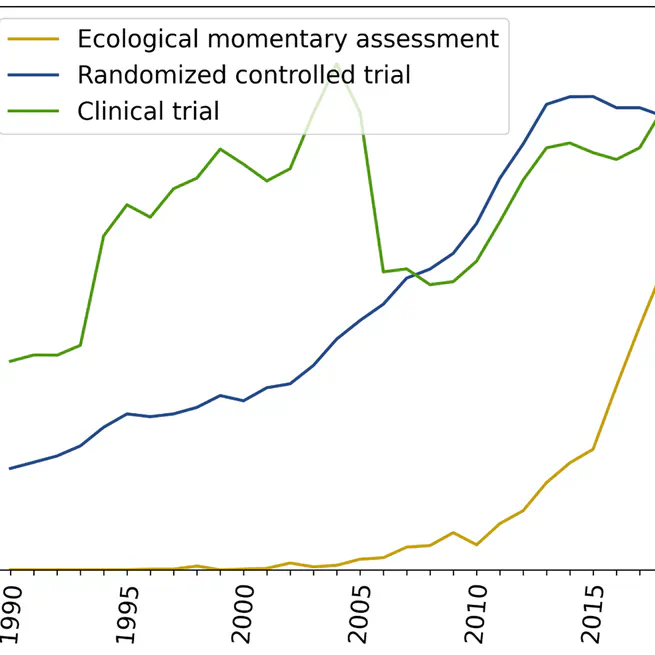
A Tutorial on Analyzing Ecological Momentary Assessment Data in Psychological Research With Bayesian (Generalized) Mixed-Effects Models
In this tutorial, we introduce the reader to analyzing ecological momentary assessment (EMA) data as applied in psychological sciences with the use of Bayesian (generalized) linear mixed-effects models.
Mar 1, 2024
The daily association between affect and alcohol use: A meta-analysis of individual participant data
This study meta-analyzed individual participant data from 12,394 individuals across 69 studies in which participants reported their emotional state and alcohol use for multiple days. Contrary to theoretical models of alcohol use, the findings indicated that people are not more likely to drink and do not consume more alcohol on days that they report higher negative affect but are more likely to drink on days that they report higher positive affect.
Jul 1, 2023
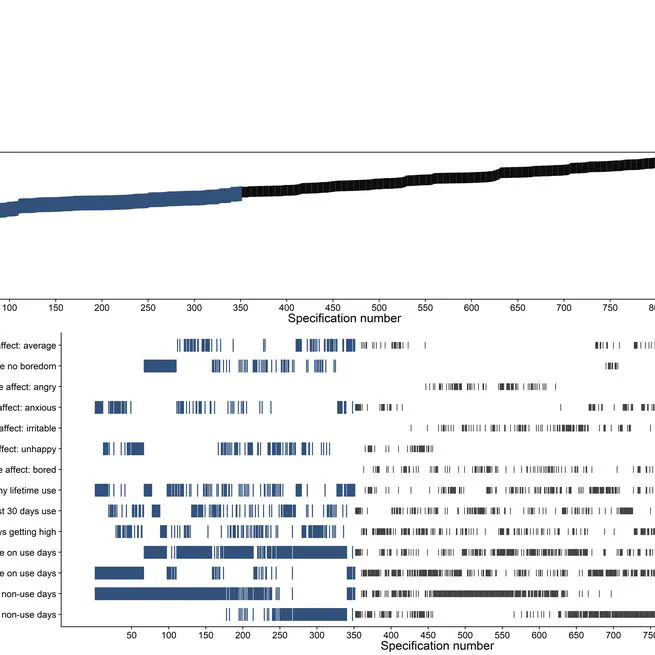
Exploring associations between affect and marijuana use in everyday life via specification curve analysis
We show via Specification Curve Analysis across hundreds of models that there is little evidence for affect regulation of cannabis in regularly using young adults.
May 1, 2023